Genomic evaluation of clinical samples and microbiomes have improved our understanding of the role of pathogens in clinical microbiology. Being highly sensitive, next generation sequencing (NGS) is the gold standard in pathogen identification and can overcome several limitations of current day diagnostics (1). A genomics-based approach for pathogen detection has the potential to be a one-test solution to identify several pathogens simultaneously. The utility of implementing genomics in infectious disease and particularly in critically ill patients has been explored but challenges remain (2). A diagnostic solution for the detection of pathogens needs to consider:
- Turnaround-time (TAT)
- Cost
- Comprehensivity
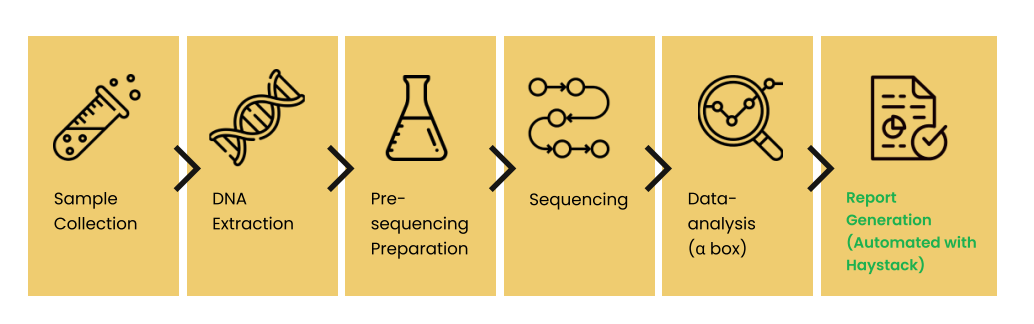
A workflow that combined target enrichment, long-read sequencing and automated bioinformatics (Figure 1) could address these challenges and was demonstrated to simultaneously identify bacteria, fungi and antibiotic resistance genes (ARGs). This strategy could overcome the issues associated with host background DNA and error rates of long read sequencing to provide accurate detection of pathogens. When tested across standard organisms, clinical isolates and blood samples from patients with suspected bloodstream infections this workflow could successfully and reproducibly identify the relevant pathogen and ARG. A blinded comparison of various clinical isolates revealed a concordance of 0.83 at species level and 0.90 at the genus level compared to standard diagnostic methods. This test could be implemented on-site as a single assay and a TAT of 12 hrs was consistently achieved (3).
Figure 1. Workflow for the simultaneous detection of bacteria, fungi and ARGs
Current methods used in clinical microbiology lack sensitivity and often rely on culture increasing TAT. Studies have already established an improved sensitivity and specificity of NGS compared with standard-of-care tests (4,5). Thus, a workflow for the direct-from-sample, on-site sequencing combined with automated genomics was demonstrated to be implementable, reproducible and feasible. Such an approach can be a viable option as the primary screening tool in clinical settings and promote a precision approach to antibiotic prescribing.
REFERENCES:
- Gu W, Miller S, Chiu CY. Clinical Metagenomic Next-Generation Sequencing for Pathogen Detection. Annu Rev Pathol. 2019 Jan 24;14:319-338. doi:10.1146/annurev-pathmechdis-012418-012751. )
- Rossen JWA, Friedrich AW, Moran-Gilad J; ESCMID Study Group for Genomic and Molecular Diagnostics (ESGMD). Practical issues in implementing whole-genome-sequencing in routine diagnostic microbiology. Clin Microbiol Infect. 2018 Apr;24(4):355-360. doi: 10.1016/j.cmi.2017.11.001.
- Kuruwa S, Zade A, Shah S, Moidu R, Lad S, Chande C, Joshi A, Hirani N, Nikam C, Bhattacharya S, Poojary A, Kapoor M, Kondabagil K, Chatterjee A. An integrated method for targeted Oxford Nanopore sequencing and automated bioinformatics for the simultaneous detection of bacteria, fungi and ARG. J Appl Microbiol. 2024 Feb 12:lxae037. doi: 10.1093/jambio/lxae037.
- Grumaz S, Grumaz C, Vainshtein Y, Stevens P, Glanz K, Decker SO, Hofer S, Weigand MA, Brenner T, Sohn K. Enhanced Performance of Next-Generation Sequencing Diagnostics Compared With Standard of Care Microbiological Diagnostics in Patients Suffering From Septic Shock. Crit Care Med. 2019 May;47(5):e394-e402. doi: 10.1097/CCM.0000000000003658.
- Zhang Y, Lu X, Tang LV, Xia L, Hu Y. Nanopore-Targeted Sequencing Improves the Diagnosis and Treatment of Patients with Serious Infections. mBio. 2023 Feb 28;14(1):e0305522. doi: 10.1128/mbio.03055-22.